KnoWhy #850 | April 28, 2026
Why do Parts of Old Testament Stories Seem to Contradict Themselves?
Post contributed by
Scripture Central
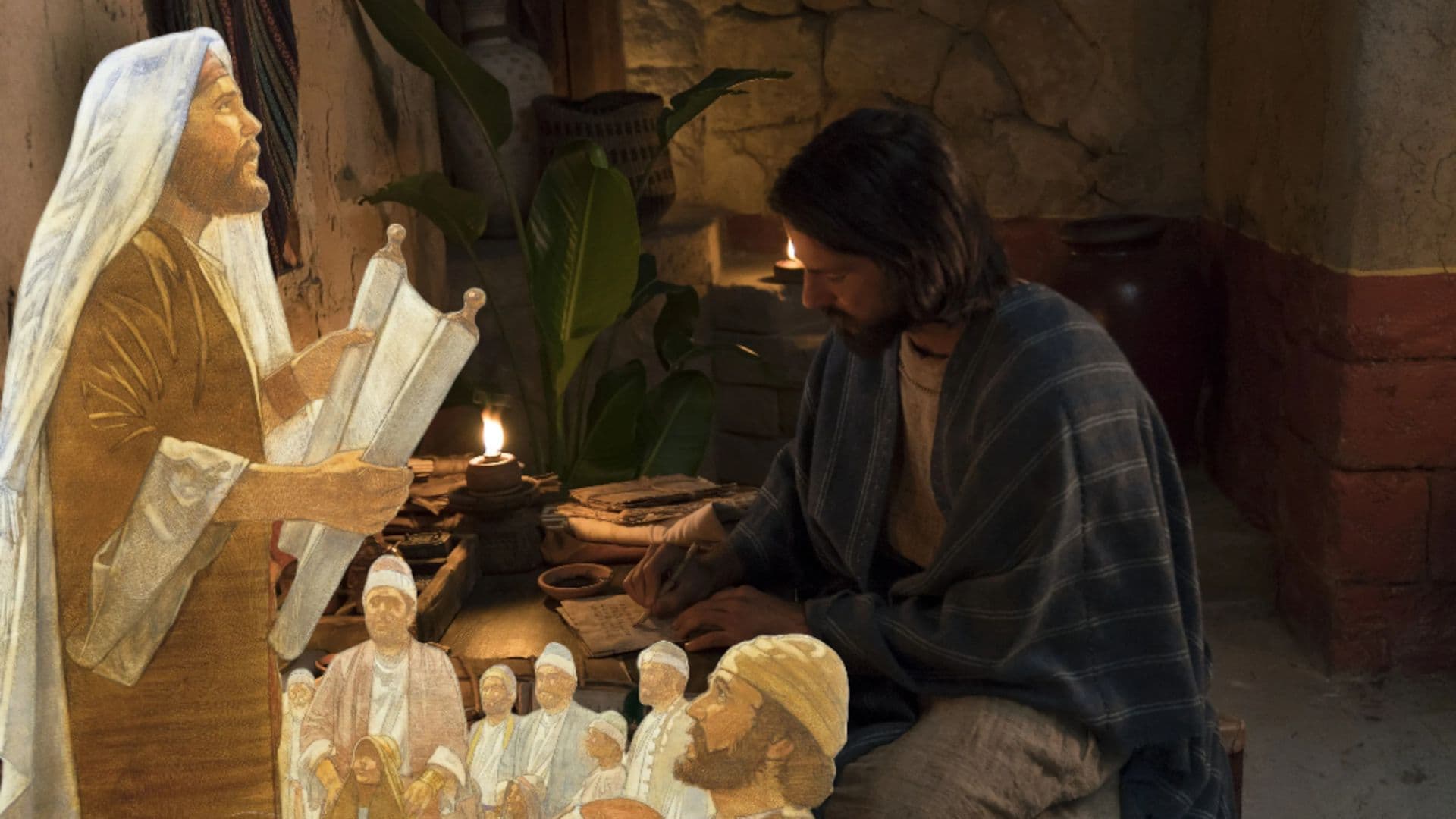
“These caused the children of Israel, through the counsel of Balaam, to commit trespass against the Lord.” Numbers 31:16
The Know
Sometimes, when reading the Old Testament, one finds things that might seem inconsistent. In Numbers 22-24, for example, Balaam blesses the Hebrews in the name of the Lord, but in Numbers 31:16, he causes them to sin against the Lord. Genesis 6:19-20 states that Noah was to bring two of each kind of animal into the Ark, but then in Genesis 7:1-2, he is told to take seven of some kinds of animals. Similarly, Genesis 37:28 states that it was the Ishmaelites who sold Joseph into Egypt, but by verse 36 it is the Midianites who take him into Egypt. Small inconsistencies like these have prompted a variety of explanations by readers over the years.
One of the most common explanations for these kinds of inconsistencies is known as the Documentary Hypothesis. This theory states that the Books of Moses consists of four different authors or sources: J, E, D, and P.1 Two of these sources, J and E, are named after the way these sources refer to God. J usually refers to God as Yahweh (the first letter of which was spelled with a J by the German-speakers who came up with the theory), and so this author is known as the Yahwist.2 E usually refers to God as Elohim and this author is known as the Elohist.3 Of course, Latter-day Saint theology considers Elohim and Jehovah to be separate deity, so one ancient author writing about both would likely be considered two authors by scholars who do not believe Elohim and Jehovah were two entities. The author or source labelled D, the Deuteronomist, is named after the book Deuteronomy because it is generally thought they were the main author of that book and share the concerns that are unique to that book.4 P, the Priestly Source, mainly addresses priests and their concerns (much of Leviticus is assigned to P, for example).5 The Documentary Hypothesis states that an editor or redactor combined all these sources together at some point but kept much of the source material intact, including contradictions.6
This would explain, for example, why some parts of Numbers are positive about Balaam and some are negative, or why there seem to be two sets of instruction for how many animals Noah was to take onto the ark.7 The more scholars tried to define the nature of these imagined sources (no ancient document reflecting one of these sources has ever been found), the more the theory seemed to work. There seems to be internal consistencies within these sources such as the names used for God, or the names used for the mountain of God (Horeb in some sources and Sinai in others).8 Some scholars such as Julius Wellhausen even tried to assign dates to these sources, with J being the oldest, followed by E, which was eventually followed by D shortly before the exile in Babylon, with P being created during the exile.9 Everything seemed to work perfectly. And that was the problem.
The more scholars looked at other ancient texts, the more they realized that sources are rarely easy to identify as the scholars seemed to think, and other theories began to gain popularity.10 Some scholars began to posit a large number of sources which were eventually stitched together, called the Fragmentary Hypothesis.11 Others posit a smaller number of sources with some people uniting J and E into one source leaving P, non-P and D, positing that much of what appears to be separate sources is due to a variety of redactional layers over time.12 Some scholars posited that another source, H for Holiness, likely made up the latter half of Leviticus, which has some distinctions from the first half believed to be written by P.13
The Why
Amid this confusion, some scholars began to point out that ancient people read the Torah as a unified whole for thousands of years, and that modern readers could do the same.14 One such scholar, Robert Alter, noticed that some things that a source critic might assume was a variation due to separate sources could be literary devices used by a single author.15 For example, an author might repeat certain narrative plots, which Alter called type-scene, with some variation for the purpose of providing comparative material and giving deeper meaning.16 In Genesis, for example, Sarah finds herself in danger when Abraham tries to pass her off as his sister when visiting a foreign land. This happens more than once, and later happens to Rebekah.17 Each time an author told this story, however, they might change the story in subtle but important ways, giving insights into the characters in that particular part.18 Therefore, far from simply being an issue of different sources, the repetitions with significant differences helped to tell the reader something important if they knew what to look for.
Even if the presence of more than one source is likely, one can still read the apparent discontinuities as part of the artistry of the narrative. In Genesis 37, for example, the confusion regarding who took Joseph out of the pit and sold him into slavery, mentioned earlier, can be seen as reflecting Joseph’s own confusion as he is taken to Egypt against his will.19 The same is true of Genesis 1 and 2, which can look like two different creation accounts being stitched together. Genesis 1 is generally held to be written by P (concerned with order and calls God Elohim), and Genesis 2 is usually thought to be written by J (concerned with human drama and calls God Jehovah).20 However, the two chapters can be read as a unity to teach the reader something about God. In Genesis 1, one is reminded of the all-powerful nature of the deity. In Genesis 1, God has only to speak and things come into being. In Genesis 2, on the other hand, one sees a much more personal deity. He makes the first human out of dirt with His own hands and breathes into his nose to bring him to life. Either of these depictions of God on their own would be incomplete, but Genesis 1 and 2 together present a picture of a God who is both all-powerful and yet can have a personal relationship with regular people.21 For Latter-day Saints, the creative actions of Elohim in Genesis 1, followed by the creative actions of Jehovah in Genesis 2, could provide other insight.
Part of the reason the text can still be read as a unity, and part of the reason why people have been able to read the Pentateuch as a unity for thousands of years, is that the redactors who put any sources together did their job carefully and created a surprisingly coherent text from any disparate source material they may have had. Realizing that the Books of Moses may contain various sources can help readers understand the text a little more. Realizing that the final form of the text can be read as a unity is also important to help readers deepen their understanding of the Bible’s message that is beloved by millions of people across the world.
Jeffrey M. Bradshaw, "Sorting Out the Sources in Scripture," Interpreter: A Journal of Mormon Scripture 9 (2014): 215-272.
A. Keith Thompson, "The Brass Plates: Can Modern Scholarship Help Identify Their Contents?," Interpreter: A Journal of Latter-day Saint Faith and Scholarship 45 (2021): 81-114.
Noel B. Reynolds, "The Return of Rhetorical Analysis to Bible Studies," Interpreter: A Journal of Mormon Scripture 17 (2016): 91-98.
- 1. For an overview, see Joel S. Baden, The Composition of the Pentateuch: Renewing the Documentary Hypothesis (Yale University Press, 2012), 216-220.
- 2. For the classic approach to J and E, see Julius Wellhausen, Die Composition des Hexateuchs und der historischen Bücher des Alten Testaments (de Gruyter, 1963), 33-37.
- 3. For the relationship between J and E see Richard Elliott Friedman, “Three Major Redactors of the Torah,” in Birkat Shalom: Studies in the Bible, Ancient Near Eastern Literature, and Postbiblical Judaism Presented to Shalom M. Paul on the Occasion of his Seventieth Birthday, eds. Chaim Cohen et al. (Eisenbrauns, 2008), 38-39.
- 4. For more on D, see Paul B. Harvey, Jr. and Baruch Halpern, “W. M. L. de Wette’s ‘Dissertatio Critica …’: Context and Translation,” Zeitschrift für Altorientalische und Biblische Rechtsgeschichte 14 (2008): 47–85.
- 5. For more on P, see Avi Hurvitz, A Linguistic Study of the Relationship Between the Priestly Source and the Book of Ezekiel: A New Approach to an Old Problem (Gabalda, 1982).
- 6. For the notion of one redactor of the entire Torah, see Baden, The Composition of the Pentateuch, 219.
- 7. The flood narrative is generally thought to be a combination of J and P. See Richard Elliott Friedman, The Bible with Sources Revealed (HarperCollins, 2003), 42-45.
- 8. Friedman, The Bible with Sources Revealed, 8, 10.
- 9. For an overview of this approach and some issues with it, see Baden, The Composition of the Pentateuch, 218.
- 10. See, for example, F. V. Winnet, “Re-examining the Foundations,” Journal of Biblical Literature 84 (1965): 1– 19; J. Van Seters, Abraham in History and Tradition (Yale University Press, 1975); R. Rendtorff, “Der ‘Jahwist’ als Theologe? Zum Dilemma der Pentateuchkritik,” Congress Volume Edinburgh 1974 (ed. G. W. Anderson, et al. (Brill, 1975), 158–166.
- 11. For an example of this in Numbers, see M. Noth, Das vierte Buch Mose: Numeri (Vandenhoeck & Ruprecht, 1966), 8.
- 12. See, for example, P. Weimar and E. Zenger, Exodus: Geschichten und Geschichte der Befreiung (Katholisches Bibelwerk, 1995); F.-L. Hossfeld, Der Dekalog: Seine späten Fassungen, die originale Komposition und seine Vorstufen (Universitätsverlag, 1982); J. Vermeylen, “La formation du Pentateuque à la lumière de l’exégèse historico-critique,” Revue théologique de Louvain 12 (1985): 324–346; M. Konkel, Sünde und Vergebung: Eine Rekonstruktion der Redaktionsgeschichte der hinteren Sinaiperikope (Exodus 32–34) vor dem Hintergrund aktueller Pentateuchmodelle (Mohr Siebeck, 2008).
- 13. Compare I. Knohl, The Sanctuary of Silence: The Priestly Torah and the Holiness School (Fortress, 1995; reprint, Eisenbrauns, 2007).
- 14. For an interesting example, see García López, “Deut 34, Dtr History and the Pentateuch,” in Studies in Deuteronomy: In Honour of C. J. Labuschagne on the Occasion of His 65th Birthday, ed. F. García Martínez et al. (Brill, 1994), 61 (emphasis original). He is drawing on Erhard Blum, Studien zur Komposition des Pentateuch (de Gruyter, 1990), 76–88.
- 15. For an overview, see Robert Alter, “Biblical Type-Scenes and the Uses of Convention.” Critical Inquiry 5, no. 2 (1978).
- 16. Alter, “Biblical Type-Scenes,” 355–359.
- 17. Alter, “Biblical Type-Scenes,” 357.
- 18. Alter, “Biblical Type-Scenes,” 361.
- 19. Gary Rendsburg, "Confused Language as a Deliberate Literary Device in Biblical Hebrew Narrative," Journal of Hebrew Scriptures 2 (1999).
- 20. Richard Elliott Friedman, Who Wrote the Bible? (HarperCollins, 1997), 236-237.
- 21. Friedman, Who Wrote the Bible?, 236-237.