Evidence #553 | July 30, 2026
Book of Moses Evidence: Water and Fire
Post contributed by
Scripture Central
Abstract
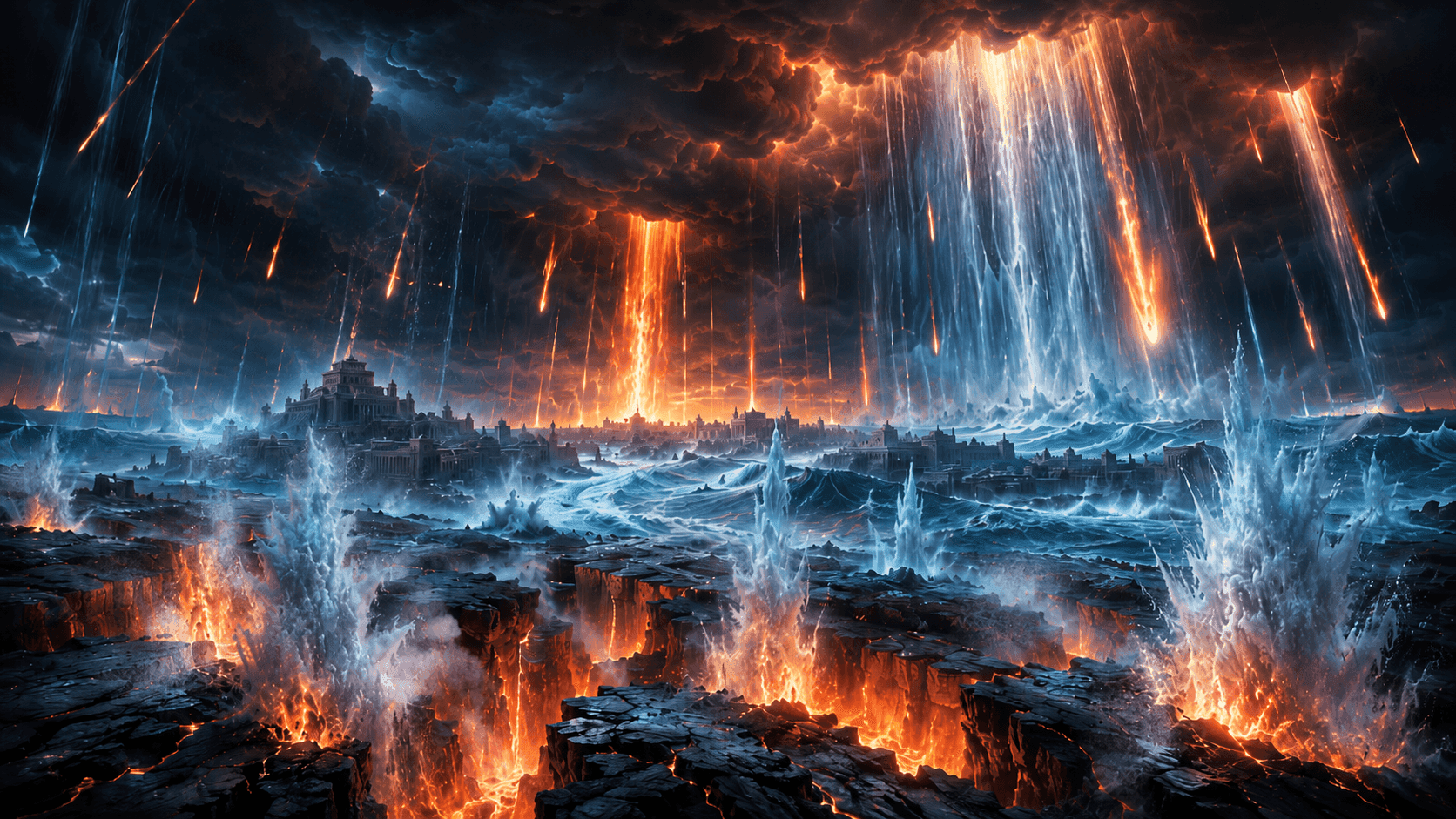
A theme of fire is emphatically interwoven with the imagery of the flood in Moses 7:34. This dual water/fire motif also arises in various extrabiblical flood traditions.When explaining to Enoch the destruction that would come upon the wicked, the Lord declared, “the fire of mine indignation is kindled against them; and in my hot displeasure will I send in the floods upon them, for my fierce anger is kindled against them” (Moses 7:34).1 Although expressions such as “hot displeasure” and “fire of … indignation” being “kindled” are fairly conventional biblical idioms, their concentrated repetition immediately before and after the declaration that God would “send in the floods” creates an unusually emphatic association between fiery wrath and the coming deluge.
The intermixing of these images is especially striking because fire and water are typically viewed as opposing elements. Hugh Nibley, for example, described this “striking passage” as possessing a “curious mixture of fire and water.” Nevertheless, he noted that the “same oddity” can be found in various extrabiblical sources.2
Fire and Boiling Water from Heaven and Hell
One of the earliest and most important attestations of this duality comes from the Aramaic Book of Giants, which recounts ominous dreams that warned the giants of an impending calamity. In one such dream, a giant saw a large garden in which one tree and its three shoots (apparently representing Noah and his three sons) were preserved, while the rest of the trees were destroyed by both water and fire:
- [there was a big garden … and it] had gardeners, and they were watering
- [every tree in the garden … and] huge [shoo]ts sprang forth from their root,
- [and from one tree there sprang forth three roots.] I was [looking] until tongues of fire [came down] from [heaven]
- I continued looking until ]the [dus]t [was covered] with all the waters, and the fire was burning all
- [the trees of this entire paradise, but it did not burn the tree and its shoots on] the earth as […]
- […]’. Here is the end of the dream.3
The context of this dream—especially when compared with Genesis, 1 Enoch, and the broader narrative of the Book of Giants—suggests that the destruction by water and fire anticipates the coming flood.4 The comparison is especially noteworthy because the motif appears within an antediluvian narrative centered on the giants and Enoch. Enoch occupies a significant revelatory role, much as he does in Moses 6–7, and is the figure to whom the giants turned for an interpretation of their dreams.
Several Islamic sources connect the prophet Enoch to a similar tradition. One of them reports that Enoch “authored many books for the people of his time containing information about terrestrial and celestial things …. He was the first person who warned of the Flood, and he saw that a heavenly affliction would come upon the earth from water and fire.”5
A closely related combination of giants, the flood, and fiery punishment appears in several Jewish traditions as well. As reported in Midrash Tanchuma, the “men of the generation of the flood were exceedingly strong and tall …. After the Holy One, blessed be He, realized that they would not be drowned by the waters that gushed forth from the deep because of their height, He sent the fire upon them from above.”6
In other Jewish accounts, the fiery dimension of the flood is expressed not through a separate outpouring of fire but through the waters themselves being supernaturally heated in Gehenna, as depicted in Bereshit Rabbah:
The sentence of the generation of the Flood lasted over the course of twelve months—they received their [full] punishment, and they will have a share in the World to Come. It is as Rabbi Yoḥanan said: Each and every drop that the Holy One blessed be He rained down upon them, He would boil it in Gehenna and take it out and rain it down upon them. That is what is written: “When scorched, they disappear [nitzmatu]” (Job 6:17). Their scorching was absolute [laḥlutanit].7
A text called Zevachim elaborates extensively upon this tradition of heated waters as part of a disagreement over the extent of the Flood and its destructive power. Interestingly, the passage interprets the boiling heat of the waters as a punishment corresponding to sexual promiscuity:
With regard to the flood, it is stated: “All in whose nostrils was the breath of the spirit of life, whatsoever was on the dry land, died” (Genesis 7:22). Granted, according to my opinion, that I say the flood descended upon Eretz Yisrael, due to that reason all living creatures on Earth died, even those in Eretz Yisrael. But according to your opinion that the flood did not descend on Eretz Yisrael, why did they die there? Rabbi Yoḥanan responds: They died due to the heat that accompanied the floodwaters, and that spread to Eretz Yisrael as well.
The Gemara notes that this is in accordance with the statement of Rav Ḥisda, as Rav Ḥisda says: The generation of the flood sinned with boiling heat, i.e., forbidden sexual intercourse, and they were punished with the boiling heat of the flood waters. As it is written here, with regard to the flood: “And God remembered Noah and every living creature and all the cattle that were with him in the ark; and God made a wind to pass over the earth and the waters calmed [vayashoku hamayim]” (Genesis 8:1); and it is written there, with regard to the execution of Haman: “So they hanged Haman on the gallows that he had prepared for Mordecai. Then the king’s boiling anger was assuaged [shakhakha]” (Esther 7:10). This latter verse indicates that a matter is assuaged from heat; similarly, the flood waters were hot.8
The association of heated waters with the erotic passions of the antediluvian generation can be found in several other accounts as well.9 This imagery may be significant when compared with Moses 8:15: “And the Lord said unto Noah: The daughters of thy sons have sold themselves; for behold mine anger is kindled against the sons of men, for they will not hearken to my voice.” This combination of elements has no close counterpart in the Genesis account.10
Other sources say the fiery water came from beneath. The Quran, for instance, reports how waters burst forth from the earth, which it describes as an “oven” (11:40; 23:27). Jewish accounts, as seen in Pirke de Rabbi Eliezer, provide similar descriptions:
[The wicked] said: If He bring from heaven the waters of the Flood upon us, behold, we are of high stature, and the waters will not reach up to our necks; and if He bring the waters of the depths against us, behold, the soles of our feet can close up all the depths. What did they do? They put forth the soles of their feet, and closed up all the depths. What did the Holy One, blessed be He, do? He heated the waters of the deep, and they arose and burnt their flesh, and peeled off their skin from them, as it is said, “What time they wax warm, they vanish; when it is hot, they are consumed out of their place” (Job 6:17). Do not read thus (“When it is hot,” בחֻמו), but (read) “in his hot waters” (בחמימיו).11
The association of heated waters with the subterranean deep also brings this tradition into contact with imagery of Gehenna and the underworld. Particularly significant in this regard is 1 Enoch 67:6, where fire and water co-exist in the region prepared for the punishment of the fallen angels: “there was produced from that bronze and fire a smell of sulfur (which) blended with those waters. This valley of the perversive angels shall (continue to) burn punitively underneath that ground; in respect to its troughs, they shall be filled with rivers of water by which those angels who perverted those who dwell upon the earth shall be punished.”12 According to James VanderKam, “The paradoxical presence of churning waters in the fiery valley suggests an allusion to the flood,” a topic discussed just prior to this imagery.13
Another significant feature of the water/fire imagery in 1 Enoch is that it appears within a broader cluster of correspondences with Moses 7. As shown in the following chart, both texts describe (1) a prison prepared for the wicked or fallen beings, (2) God’s hand sheltering Noah’s ark, (3) the restraint of the waters, (4) the preservation of Noah’s seed, and (5) Noah’s protection from his enemies:14
Topic | Moses 7 | 1 Enoch |
Fire and Water | 34 the fire of mine indignation is kindled against them; and in my hot displeasure will I send in the floods upon them, for my fierce anger is kindled against them | 67:6 there was produced from that bronze and fire a smell of sulfur (which) blended with those waters. This valley of the perversive angels shall (continue to) burn punitively underneath that ground; in respect to its troughs, they shall be filled with rivers of water by which those angels who perverted those who dwell upon the earth shall be punished |
Prison for the Wicked | 38 But behold, these which thine eyes are upon shall perish in the floods; and behold, I will shut them up; a prison have I prepared for them. | 67:4 And they shall imprison those angels who revealed oppression in that burning valley which my grandfather Enoch had formerly shown me |
God Held the Ark in His Hand | 43 Wherefore Enoch saw that Noah built an ark; and that the Lord smiled upon it, and held it in his own hand; but upon the residue of the wicked the floods came and swallowed them up. | 67:2 At this time the angels are working with wood (making an ark) and when it is completed, I shall place my hands upon it and protect it, |
God Stayed the Floods | 51 And the Lord could not withhold; and he covenanted with Enoch, and sware unto him with an oath, that he would stay the floods; that he would call upon the children of Noah; | 66:2 But the Lord of the Spirits gave an order to the angels who were on duty that they should not raise the (water) enclosures but guard (them)—for they were the angels who were in charge of the waters. |
Noah’s Seed Will Be Preserved | 52 And he sent forth an unalterable decree, that a remnant of [Noah’s] seed should always be found among all nations, while the earth should stand; | 65:12 He has preserved your name for the holy ones; he will protect you from those who dwell upon the earth; he has preserved your righteous seed for kingship and great glory; and from your seed will emerge a fountain of the righteous and holy one without number forever. 67:3 I shall strengthen your seed before me forever and ever as well as the seeds of those who dwell with you; I shall not put it to trial on the face of the earth; but it shall be blessed and multiply on the earth in the name of the Lord.” |
Noah’s Divine Protection | 8:18 And in those days there were giants on the earth, and they sought Noah to take away his life; but the Lord was with Noah, and the power of the Lord was upon him. | 65:12 He has preserved your name for the holy ones; he will protect you from those who dwell upon the earth. |
1 Enoch 102:1, which depicts the final judgment of the wicked, also has relevance: “Then, when [the Most High] hurls against you the flood of the fire of your burning, where will you flee and be saved?”15 Although this passage concerns the final judgment rather than the destruction in Noah’s day, its description of a “flood of fire” in a judgment context is still notable.
Another intriguing parallel can be seen in 3 Enoch, which describes how “rivers of fire flow out” from the throne of God and how each river eventually “falls on the heads of the wicked in Gehinnom” (3 Enoch 33:4–5).16 To explain this phenomenon, the text quotes Jeremiah 23:19: “Now a storm of the Lord breaks, a tempest whirls, it bursts over the head of the wicked.” The passage thus portrays fiery punishment as descending in a storm-like torrent directed against the wicked in the underworld. This imagery meaningfully corresponds with Moses 7:34–38, where fiery wrath, an overwhelming deluge, and a prison prepared for the wicked all appear in close proximity. It is also fascinating that both texts either quote or paraphrase a specific biblical passage—namely Psalm 89:14—shortly before they invoke these related images of divine judgment.17
Dual Water/Fire Calamities
Other extrabiblical sources pair destruction by water and fire but treat them as separate calamities that may or may not be temporally proximate. This can be seen in the writings of Josephus, who relates how sacred knowledge of the heavens was inscribed onto two separate pillars in order to preserve them from coming destruction: “And that their inventions might not be lost before they were sufficiently known, upon Adam’s prediction that the world was to be destroyed at one time by the force of fire, and at another time by the violence and quantity of water, they made two pillars, the one of brick, the other of stone” (Jewish Antiquities 1.70–71).18 Although this account does not appear to combine water and fire within a single event, it nevertheless preserves an antediluvian tradition in which the two elements function as complementary instruments of world judgment.
A similar account is given in the Life of Adam and Eve. After Adam’s death, Eve reported that the angel Michael told them the following: “Because of your collusion, our Lord will bring over your race the wrath of his judgment, first by water and then by fire; by these two the Lord will judge the whole human race” (LAE 49:3).19 Eve then instructed her posterity to make two tablets, one of clay and one of stone, to preserve a knowledge of Adam and Eve and their teachings.
A more overtly Enochic version of the tradition appears in a work known as Palaea Historica:
The giants heard that the righteous Noah was building an ark because of the flood of water and began to laugh at him. But Enoch, who was still around, said to the giants, “The earth will be consumed either by water or by fire.” And the righteous Enoch was doing nothing else except to occupy himself recording on marble and on brick the mighty acts of God from the beginning.20
Among these sources, the Enochic connection surfaces in a variety of ways, even in texts that don’t specifically name him. As explained by Andrei Orlov, “Even a brief review of these documents shows that the ‘two stelae’ narrative contains traces of Enochic traditions.”21 Although ambiguity involving the temporal distinctness of the calamities in some of these accounts may limit their connection with Moses 7:34, it remains significant that primeval traditions repeatedly pair water and fire together as corresponding forms of divine destruction.22
Potential 19th-Century Sources
A historical assessment of these parallels should also consider whether Joseph Smith could have accessed comparable imagery in his nineteenth-century environment. It must be acknowledged, for example, that Smith could have encountered the suggestive heat-and-water imagery from the Quran (11:40; 23:27). However, the water/fire duality is muted in this text, and the Quran was neither widely read nor regarded as a trustworthy religious authority within Smith’s Protestant environment.
Another possibility is that Smith encountered the water/fire motif in 1 Enoch, since an English translation of that text had been available since 1821. Several considerations, however, make direct dependence unlikely. First of all, its initial European print run appears to have been quite limited, and there is no evidence Smith was aware of the work before 1830. He could possibly have accessed its contents through secondary sources, since summaries and limited extracts of its material circulated in America before the translation of the Book of Moses. Yet such sources predominantly focused on the Book of Watchers (1 Enoch 1–36) and were unlikely to include the relevant material from chapters 67 or 102.23 The final issue is that these portions of 1 Enoch are primarily about the condition of the fallen Watchers or the fate of the wicked at the final judgment. The connection to the flood is therefore allusive rather than explicit.
The writings of Josephus were also available in English well before Smith published the Book of Moses.24 Yet, as previously mentioned, this source appears to treat destruction by water and fire as separate calamities. Although still typologically relevant, the relationship with Moses 7:34 is comparatively weak.
As for the rest of the sources discussed throughout this article, most would not have been realistically accessible leading up to 1830. Some had not yet been discovered or published by Western scholars, while others remained untranslated, highly obscure, or available only to specialists with access to the relevant languages and manuscripts.
That being said, Smith might conceivably have encountered some version of the tradition through a secondary source, such as a Bible commentary, since some scholars in his day were acquainted with Jewish interpretive traditions and possessed the linguistic training needed to consult them. After searching through a variety of such sources, the researchers of this article did actually find one such example. This comes from John Gill’s commentary on Genesis 7:22, which describes the widespread destruction of animal life during the flood. Gill adds, “Some pretend it to be the opinion of some Jewish writers, that the fishes did die, the waters being made hot, and scalded them; but this fable I have not met with.”25 While Gill was apparently aware of the boiling water tradition, his knowledge was indirect and he immediately distanced himself from it, using pejorative terms such as “pretend” and “fable.” These preliminary findings, although inconclusive, suggest that such traditions were uncommon and may have been viewed with skepticism in Smith’s 19th-century environment.
Conclusion
The concentrated repetition of fire imagery in Moses 7:34 strongly implies that the text is intentionally and emphatically associating fire with the impending flood. Although the individual expressions are typical biblical idioms, their accumulation surrounding the flood imagery produces a striking fusion of heat, fire, and inundation. For most readers, this duality is not intuitive, as water is typically seen as antithetical to fire. Nor is there anything in the Genesis account that would tip Joseph Smith off to this detail.
The fact that this “oddity,” as Nibley described it, is so widely attested in extrabiblical sources is therefore quite remarkable. Other ancient and medieval texts not only associate the destruction in Noah’s day with fire, heated waters, or corresponding judgments by water and fire, but they also situate this imagery within a broader complex involving Enoch, the giants, sexual corruption, the punishment or imprisonment of the wicked, divine protection of Noah and the ark, and the preservation of Noah’s seed. The Book of Giants arguably provides the most significant single example of this convergence, as it combines destruction by water and fire in an antediluvian setting involving Enoch and the giants. Yet the correspondences surrounding 1 Enoch 65–67 and 3 Enoch 33 are also significant, as they establish that the motif belongs to a broader constellation of elements that are likewise contained in the Book of Moses.
While it remains possible that Joseph Smith encountered some portion of this imagery in his nineteenth-century environment, the presently identified sources provide only partial explanations. The Quran, for example, offers suggestive heat-and-water imagery but lacks the Enochic and giant traditions. Josephus pairs destruction by water and fire but separates the two calamities. John Gill mentions heated waters but immediately dismisses the tradition. And the most relevant passages in 1 Enoch are only allusive to the flood and were unlikely to have been readily accessible to Smith before 1830. For these and other reasons, no single source offers an adequate account of the full convergence of imagery and narrative context found within Moses 7–8.
That being the case, the water/fire motif in Moses 7:34 functions as meaningful evidence supporting the authenticity of the Book of Moses. Its force lies not merely in the juxtaposition of the two elements, but in the way this duality participates in a wider array of Enochic and antediluvian traditions.
Further Reading
Jeffrey M. Bradshaw and David J. Larsen, In God’s Image and Likeness 2: Enoch, Noah, and the Tower of Babel (The Interpreter Foundation and Eborn Books, 2014), 57, 127, 146.
Hugh Nibley, Enoch the Prophet, The Collected Works of Hugh Nibley, Volume 2 (FARMS, 1986), 199–200.
Bible
Psalm 89:14
Book of Moses
Moses 6:27
Moses 7:1
Moses 7:34
Moses 8:15
- 1. It should be pointed out that, as a Hebrew idiom, the phrase “fierce anger” holds the connotation of burning. See https://www.blueletterbible.org/lexicon/h2740/kjv/wlc/0-1/. Other passages from the Book of Moses have complementary fire imagery. For example, Moses 7:1 declares, “Behold, our father Adam taught these things, and many have believed and become the sons of God, and many have believed not, and have perished in their sins, and are looking forth with fear, in torment, for the fiery indignation of the wrath of God to be poured out upon them.” The language of this fiery wrath being “poured” upon the wicked may suggest rain in this context. Fire language also arises in Moses 6:27 in connection to the wicked and their impending destruction and banishment to hell: “for thus saith the Lord: I am angry with this people, and my fierce anger is kindled against them.” The imagery arises again in Moses 8:15, specifically in connection to the immorality of the people: “And the Lord said unto Noah: The daughters of thy sons have sold themselves; for behold mine anger is kindled against the sons of men, for they will not hearken to my voice.” When read in context, it may also be significant that Moses 6:64–66 pairs water and fire together in relation to baptism: “And it came to pass, when the Lord had spoken with Adam, our father, that Adam cried unto the Lord, and he was caught away by the Spirit of the Lord, and was carried down into the water, and was laid under the water, and was brought forth out of the water. … And he heard a voice out of heaven, saying: Thou art baptized with fire, and with the Holy Ghost.” For possible ways in which the doctrine of baptism may relate to the earth itself, see Paul Y. Hoskisson and Stephen O. Smoot, “Was Noah’s Flood the Baptism of the Earth?,” in Let Us Reason Together: Essays in Honor of the Life’s Work of Robert L. Millet, ed. J. Spencer Fluhman and Brent L. Top (BYU Religious Studies Center, 2016), 163–188.
- 2. Hugh Nibley, Enoch the Prophet, The Collected Works of Hugh Nibley, Volume 2 (FARMS, 1986), 199. Note that only some of the following examples were cited by Nibley.
- 3. Loren T. Stuckenbruck, “The Aramaic Book of Giants,” in Old Testament Pseudepigrapha: More Noncanonical Scriptures, vol. 2, ed. James R. Davila and Richard Bauckham (William B. Eerdmans, 2025), 76; brackets, underlining, and ellipses are from the source.
- 4. See, for example, the proposed (reconstructed) summary of the text in Stuckenbruck, “The Aramaic Book of Giants,” 63: “As some giants remain hopeful that they will not be punished for their deeds, Ohyah and Hahyah are given a second pair of ominous dreams with judgment scenes, respectively, one by water and fire and another of judgment in a divine court descended to earth. … It is possible, though not certain, that Enoch’s second message was followed by a brief narrative regarding events of the great flood.”
- 5. Abū Maʿshar apud Ibn Abī Uṣaybiʿa, K. ʿUyūn al-Anbāʾ fī ṭabaqāt al-aṭibbāʾ (ed. Najjār); as cited in John C. Reeves and Annette Yoshiko Reed, Enoch from Antiquity to the Middle Ages: Sources from Judaism, Christianity, and Islam (Oxford University Press, 2018), 96. For similar accounts, see pp. 113–114.
- 6. Midrash Tanchuma, Noah 7:4, online at sefaria.org. Translation derived from Samuel A. Berman, trans., Midrash Tanhuma-Yelammedenu (KTAV Publishing House, 1996), 55. In his collection of ancient and medieval Jewish traditions, the German author Micha Josef bin Gorion recounts a very similar tradition: “What did the Lord do? He caused a flood to fall upon them from above. But their strength was firm and their stature great, and it was impossible to overcome them. And when the Lord saw that neither the fountains of the deep nor the flood of heaven had any power against them, he caused a rain of fire to fall upon them from heaven.” Micha Josef bin Gorion, Die Sagen der Juden, vol. 1, Von der Urzeit: Jüdische Sagen und Mythen (Literarische Anstalt Rütten & Loening, 1919), 195. This text was translated from German by ChatGPT and verified by Gemini. Here is the original German text: “Was tat der Herr? Er ließ von oben eine Flut auf sie niederfallen. Aber fest war ihre Kraft und groß ihr Wuchs, nicht war es möglich, ihnen beizukommen; und da der Herr sah, daß nicht die Brunnen der Tiefe noch die Flut des Himmels etwas über sie vermochten, ließ er vom Himmel auf sie einen Feuerregen fallen, wie es auch heißt: Das Übrige fraß das Feuer.” This source was also cited in Nibley, Enoch the Prophet, 199, who summarized the passage as follows: “The rains of the Flood were intermingled with showers of fire from heaven.” Similar imagery of fiery water falling from heaven will be discussed further on in connection to 3 Enoch 33:4–5.
- 7. Bereshit Rabbah 28:9. Translation by The Sefaria Midrash Rabbah, 2022, online at sefaria.org. Bracketed text in the original.
- 8. Zevachim 113b:3–4, online at sefaria.org. Translation derives from the William Davidson edition of the Talmud. Note that the discussion about the heated waters continues at greater length beyond the material quoted here.
- 9. See Pirkei DeRabbi Eliezer 22:9, Rosh Hashanah 12a:4, and Babylonian Talmud, Sanhedrin 108b:3. In the immediately preceding verse of the latter text, an interesting discussion leads up to this topic: “They said to him: Old man, why are you building this ark? Noah said to them: The Holy One, Blessed be He, is bringing a flood upon you. They said to him: A flood of what? If it is a flood of fire, we have another item and it is called alita, and it is fireproof. And if it is a flood of water that He brings, if He brings the water from the earth, we have iron plates with which we can plate the earth to prevent the water from rising. And if He brings the water from the heavens, we have an item and it is called ekev, and some say it is called ikkesh, which will absorb the water.”
- 10. Genesis 6:2–3 may imply some type of sexual sin or inappropriate union, but nothing in the context associates it with fire.
- 11. Pirkei DeRabbi Eliezer 22:9, online at sefaria.org. Translation can also be found in Gerald Friedlander, trans., Pirḳê de Rabbi Eliezer (Hermon Press, 1970), 162.
- 12. E. Isaac, “1 (Ethiopic Apocalypse of) Enoch,” in The Old Testament Pseudepigrapha, 2 vols., ed. James Charlesworth (Doubleday, 1983–1985), 1:46. A separate and less relevant description of fire and water can be seen in 1 Enoch 17:4, in which Enoch’s heavenly escorts lifted him up “unto the waters of life, unto the occidental fire which receives every setting of the sun. And I came to the river of fire which flows like water and empties itself into the great sea in the direction of the west” (p. 22). See also 1 Enoch 71:2: “Also I saw two rivers of fire, the light of which fire was shining like hyacinth” (p. 49). These images seem to have no direct or immediate connection to the flood or the fiery punishment of the wicked.
- 13. George W. E. Nickelsburg and James C. VanderKam, 1 Enoch 2: A Commentary on the Book of 1 Enoch Chapters 37–82, ed. Klaus Baltzer (Fortress Press, 2012), 290. Specifically, VanderKam points back to 1 Enoch 66:1–2 as an immediately relevant context: “And after this, he showed me the angels of punishment, who are ready to go forth and let loose all the power of the water that is beneath the earth, that it might be for the judgment and destruction of all who reside and dwell on the earth” (p. 273).
- 14. All translations from Isaac, “1 (Ethiopic Apocalypse of) Enoch,” 45–47. The probability of all these elements randomly turning up in fairly close proximity in these separate sources seems quite low. This is especially true when considering that some of these elements are rather distinctive and could not be easily guessed or inferred from the flood account in Genesis. For further analysis of some of these elements, see Scripture Central, “Book of Moses Evidence: Hell Was ‘Prepared’,” Evidence 510 (September 3, 2025); Scripture Central, “Book of Moses Evidence: God Held Noah’s Ark,” Evidence 544 (May 13, 2026).
- 15. George W. E. Nickelsburg and James C. VanderKam, 1 Enoch 1: A Commentary on the Book of 1 Enoch Chapters 1–36, 81–108, ed. Klaus Baltzer (Fortress Press, 2001), 503. This can also be compared to the end-times language of 2 Baruch 53:7: “And it happened at the end of the cloud that, behold, it poured black water and it was much darker than all the water that had been before. And fire was mingled with it. And where that water descended, it brought about devastation and destruction.” A. F. J. Klijn, “2 (Syriac Apocalypse of) Baruch,” in The Old Testament Pseudepigrapha, 1:639.
- 16. Philip Alexander, “3 (Hebrew Apocalypse of) Enoch,” in The Old Testament Pseudepigrapha, 1:287.
- 17. See Scripture Central, “Book of Moses Evidence: Justice, Truth, Mercy, and God’s Throne,” Evidence 521 (November 26, 2025).
- 18. Flavius Josephus, The Genuine Works of Flavius Josephus, the Jewish Historian, trans. William Whiston (London: W. Bowyer, for the author, 1737). For more on Adam’s prophecies of future events, see Scripture Central, “Book of Moses Evidence: Adam’s Prophecy,” Evidence 508 (August 20, 2025).
- 19. M. D. Johnson, “Life of Adam and Eve,” in The Old Testament Pseudepigrapha, 2:292.
- 20. Palaea Historica 3:6–7. Translation by William Adler, “Palaea Historica (‘The Old Testament History’),” in Old Testament Pseudepigrapha: More Noncanonical Scriptures, vol. 1, ed. Richard Bauckham, James R. Davila, and Alexander Panayotov (Eerdmans, 2013), 606–607.
- 21. Andrei A. Orlov, “Overshadowed by Enoch’s Greatness: ‘Two Tablets’ Traditions from the Book of Giants to Palaea Historica,” Journal for the Study of Judaism 32, no. 1 (2001): 138–139.
- 22. A similar duality appears in 2 Peter 3:6–7: “Whereby the world that then was, being overflowed with water, perished: But the heavens and the earth, which are now, by the same word are kept in store, reserved unto fire against the day of judgment and perdition of ungodly men.”
- 23. The plausibility of Joseph Smith’s accessing 1 Enoch is a matter of ongoing debate and discussion among scholars. See Jeffrey M. Bradshaw and Ryan Dahle, “Could Joseph Smith Have Drawn on Ancient Manuscripts When He Translated the Story of Enoch?: Recent Updates on a Persistent Question,” Interpreter: A Journal of Latter-day Saint Faith and Scholarship 33 (2019): 308–311; Colby Townsend, “Revisiting Joseph Smith and the Availability of the Book of Enoch,” Dialogue 53, no. 3 (2020): 41–71. For further discussion of these matters, see the conclusion (and its endnotes) in Scripture Central, “Book of Moses Evidence: God Held Noah’s Ark,” Evidence 544 (May 13, 2026).
- 24. See Lincoln H. Blumell, “Palmyra and Jerusalem: Joseph Smith’s Scriptural Texts and the Writings of Flavius Josephus,” in Approaching Antiquity: Joseph Smith and the Ancient World, edited by Lincoln H. Blumell, Matthew J. Grey, and Andrew H. Hedges (BYU Religious Studies Center and Deseret Book, 2015), 356–406.
- 25. John Gill, An Exposition of the Old Testament, vol. 1 (Philadelphia: William W. Woodward, 1817), 58.